Un gând al lui Dostoievski care parca a trecut neobservat. Si totusi este, cred, unul dintre cele mai profunde!!
"Eu n-am nevoie de bani, mai bine zis de bani ca atare. Nici chiar de putere. Ceea ce-mi doresc, se poate obţine însă dacă eşti puternic, numai dacă eşti puternic; vreau să trăiesc izolat şi liniştit, având conştiinţa deplină a forţei mele! Iată cea mai completă definiţie a libertăţii, pe care lumea se străduieşte s-o formuleze de atâtă vreme! Libertatea!... Da, conştiinţa intimă a forţei tale este un simţământ înălțător, minunat. Ce poate fi mai liniştitor decât convingerea că eşti puternic?" ('Adolescentul')
Monday, October 16, 2017


Thursday, October 20, 2016
Prelegere Facultatea de Comunicare si Relatii Publice (SNSPA), oct 2016.

Bine ați venit în această universitate, care ca orice universitate este nu-i așa, înainte de toate, un templu al cunoașterii.
Încep prin a spune că sunt onorat să vorbesc studenților de anul I și trebuie să recunosc că a fost puțin surprinzător pentru mine aceasta solicitare. Am înțeles că unii dintre profesori nu au putut fi prezenți și s-a ajuns la mine. Știți, m-am simțit ca la fotbal, la execuția penaltiurilor, ești rezervă și te trezești deodată că iți cere antrenorul să execuți un penalti la loviturile de departajare… E o responsabilitate mare pentru că de multe ori acolo se pierd sau se câștigă meciurile!

Mai anul trecut eram student la doctorat aici și acum trebuie să țin un discurs la inaugurarea cursurilor! Ca să vedeți cât de valabilă în cadrul acestei instituții este zicala, adaptată bineînțeles, că orice student poartă în raniță bastonul de profesor! Cu siguranță, mâine poimâine unii dintre voi vor fi aici în locul meu.
Mă gândeam inițial să vă vorbesc despre cursul pe care îl veți avea cu mine în anul I, semestrul 2: Organizare de evenimente. O parte dintre voi mă veți întâlni foarte curând și la seminariile cursului opțional Cultură română în context european, dar asta este altă poveste.
În loc să vă descriu în detaliu în ce constă cursul meu, lucru pe care îl voi face oricum la prima oră, m-am gândit ca să vă vorbesc puțin despre scopul mai general pe care îl am eu în privința cursurilor mele și în privința voastră, evident, făcând din când în când referiri și la cursul Organizare de evenimente.
Deci, întrebarea mai generală de la care m-am gândit să pornesc este “Care este rostul educației?” Mai specific, întrebarea ar fi „Care sunt obiectivele mele în privința cursului și ce capacități doresc eu ca voi să dezvoltați până la finalul cursului”?... Așa la modul general.
Ar putea părea că voi folosi cuvinte mari și, poate abstracte, însă ceea ce vă voi spune este în fond o declarație sinceră, este convingerea mea despre rolul educației în general, și despre care ar trebui să fie rolul meu dar și al vostru aici, în acest templu al cunoașterii, după cum am spus.
Deci, care este rolul educației? Dintre multiplele definiții, mie îmi place cea menționată de mai mulți gânditori care au considerat că educația este ceea ce rămâne după ce ai uitat tot ceea ce ai învățat!

Mărturisesc că preocuparea mea permanentă la curs și la seminarii este exact asta: cu ce veți rămâne voi după ce veți uita toate teoriile și schemele și modelele pe care vi le voi preda?! Pentru că le veți uita, chiar dacă tot la acestea vă veți întoarce când vă va fi mai greu. Și asta tot din proprie experiență vă spun. Și încerc în permanență să îi învăț pe studenți ceva mai mult, ceva care să dăinuie în mintea și comportamentul lor, ceva care să îi ajute în carieră și în viață. Acum, ce este acel ceva, este mai greu de explicat în timpul scurt pe care îl am acum la dispoziție. Voi încerca doar să dau un răspuns oarecum vag la această întrebare.
Ca preambul la răspunsul meu mă voi referi la cursul de organizare de evenimente și vă întreb: Care este cel mai important eveniment pe care îl organizați voi, zi de zi, aș spune? Deci este vorba chiar de viața voastră, dacă poate fi considerată un eveniment, și cred că poate.
În consecință, un curs de organizare de evenimente ar trebui, consider eu, să vă ajute să vă organizați și viața. Dacă acceptăm că există reguli și șabloane generale, universal valabile, și acceptăm această premisă (sau corolar) tocmai pentru că suntem într-o instituție academică, atunci măcar unele dintre regulile și deprinderile pe care le vom învăța la cursul meu ar trebui sa se aplice și în viață, nu-i așa?
Așa cum am spus deja, unul din scopurile cursului meu, de fapt al cursurilor mele, este că voi încerca să vă învăț ceva care să vă ajute nu doar în meseria pe care ați ales-o, ci să vă ajute și în viață: să vă ajute să vă organizați mai bine, să rezolvați mai ușor problemele cu care vă confruntați, și, de ce nu, să ajungeți să înțelegeți mai bine lumea și pe voi înșivă. Acest ultim deziderat fiind de altfel considerat de marele filosof Socrate imperativul suprem, însăși scopul vieții: “Cunoaște-te pe tine însuți!”
Să te cunoști pe tine însuți și să știi cum să îți trăiești viața! Este într-un fel sinonim cu organizarea unui eveniment, a supremului eveniment, nu-i așa?
Bun, dar cum să iți trăiești viața? Ce trebuie să faci pentru a putea spune că îți trăiești viața în mod autentic și că viața nu trece pe lângă tine ca și cum nu ai existat? Ce trebuie să faci pentru a nu-ți rata viața? În privința organizării evenimentelor, întrebarea sinonimă ar fi, ce trebuie să facem, în general vorbind, pentru a nu rata un eveniment?
M-am gândit că un gând al unuia dintre cei mai mari filosofi ai secolului XX, Wittgenstein, ne-ar putea ajuta în acest punct al argumentării. Aflat în prima linie a frontului, când colegi și prieteni de ai lui mureau lângă el, Wittgenstein avea această dilemă fundamentală. Fiți atenți ce scria în jurnalul său:
"Pot muri într-o oră, pot muri în două ore, pot muri într-o lună sau doar în câțiva ani. Nu știu și nu pot să fac nimic în această privință: așa e viața. Cum, însă, ar trebui să trăiesc astfel încât să fiu gata să mor în fiecare moment? Trăind întru frumos și bine, până în ultima clipă".
"Pot muri într-o oră, pot muri în două ore, pot muri într-o lună sau doar în câțiva ani. Nu știu și nu pot să fac nimic în această privință: așa e viața. Cum, însă, ar trebui să trăiesc astfel încât să fiu gata să mor în fiecare moment? Trăind întru frumos și bine, până în ultima clipă".

OK, știm cu toții din literatură, artă și filosofie că doar în momentele critice ale vieții începem practic să prețuim viața, începem să ne întrebăm cum trebuie să ne trăim viața… Și de multe ori acest lucru se întâmplă prea târziu, adică înaintea propriei noastre morți.
În acest sens amintesc studiu aplicat asupra unor subiecți care nu mai aveau mult de trăit: majoritatea covârșitoare a celor intervievați au mărturisit înainte de moarte că regretă că nu și-au trăit viața așa cum trebuie, adică nu au profitat de momentele de bucurie ale vieții pentru a fi fericiți! Când și-au dat seama că asta trebuiau să facă de-a lungul vieții, era din nefericire prea târziu pentru ei! Și regretau acest lucru!
Deci, prima sugestie ar fi: trăiți-vă viața, adică luați decizii, și bucurați-vă cât nu e prea târziu!
Ce legătura are asta cu organizarea de evenimente, vă întrebați? Păi are, doar am spus că viața e un eveniment și ce e valabil pentru un concept e valabil și pentru celălalt. Asta doresc să fie practic prima regulă care aș dori să o deprindeți în organizarea de evenimente: că trebuie să luați decizii. În general, de asta le este frică tuturor oamenilor, sau la aproape toți: să ia decizii. Și trebuie să învățați ca viitori manageri de evenimente că mai bine luați o decizie proastă decât niciuna… Acesta este un corolar al tezei anterioare.
Aici îmi aduc aminte de ce am citit în manualul ofițerului când am făcut armata: “Pe timp de război, ofițerul mai bine ia o decizie proastă decât nici o decizie!”

Bun, acum să revenim la întrebarea lui Wittgenstein, cum putem trăi binele și frumosul? Ei, asta este o întrebare!
În privința frumosului, una din variantele cele mai la îndemână, ca să zic așa, și cea mai populară între oamenii care manipulează într-un fel sau altul cuvântul, adică între intelectuali, este să trăiești arta. Și Wittgenstein se referă și el în jurnalul său la această soluție, printre altele. Despre trăirea frumosului voi încerca să vă explic câte ceva la seminariile la Cursul Cultura română în context european, care le încep săptămâna viitoare cu unii dintre voi. Veți vedea acolo despre ce este vorba.
Acum, cealaltă parte a întrebării, “cum să trăim binele?”, cred că aici este și mai greu de răspuns. Mărturisesc că eu m-am întors în mediul academic să predau studenților tocmai pentru că voi încerca și eu în măsura posibilităților mele să “trăiesc binele”. Și eu cred că pot trăi binele, făcându-i pe studenții mei mai buni. Și vreau ca la cursul meu de organizare de evenimente voi să deveniți mai buni! Mai buni manageri de evenimente, manageri de proiecte în general, manageri de viață!
Pentru că asta cred eu că lipsește României: manageri, un număr critic de manageri care să schimbe la modul real ceva în această țară. Și îi putem obține doar prin Educație. Convingerea mea este că România în general va progresa doar când vom avea un sistem performant de educație. Altfel vom fi mână ieftină de lucru pentru corporațiile străine, cum suntem acum!
După ce am încercat să fac revoluții (eu am fost așa mai revoluționar la viața mea), după ce am bătut lumea asta în lung și lat, am ajuns la concluzia că cel mai util lucru pe care pot să îl fac în acest moment este să vă învăț câte ceva pe voi, studenții acestei facultăți, adică să vă învăț că sunteți buni - și doar trebuie să vă fac conștienți de acest lucru, așa cum ne povățuia Dostoievski, pentru că oricum sunteți buni. Și apoi să faceți și voi bine mai departe, să faceți facultatea asta mai bună, să faceți țara și chiar lumea asta mai bună! Cam ambițios proiectul meu, așa-i?
Eu zic că primul pas pentru a înțelege ceva este să ascultați, să învățați. De fapt să învățați să învățați! Pentru că până la urmă ăsta e scopul nostru aici la facultate, să vă învățăm să învățați. Ascultați-i și pe cei care nu vă plac. Învățați să învățați de la fiecare cate ceva. Puteți învăța de la oricare profesor de aici câte ceva important, dar și de la colegii voștri. Așa cum și eu voi învăța foarte multe de la voi! Asta este o altă deprindere pe care aș dori ca voi să o dezvoltați, așa cum spuneam, și pentru organizarea de evenimente și pentru viață!
Urmez aici sfatul lui Sigmund Freud care spunea că:

Nu treceți prin scoală doar pentru diplomă, o diplomă care probabil nu vă va folosi la prea multe dacă veniți aici doar pentru asta. Încercați în permanență să faceți ceva de care să nu vă fie rușine, de care sa fiți mândri. Chiar și un lucru aparent mic, așa ca exercițiu măcar, precum a veni la cursuri și la seminarii în mod regulat, sau, de ce nu, de a scrie un referat bun pentru un curs (vedeți că aveți referate de scris pentru mine la “Cultură” și am așteptări mari de la voi, ca să zic așa de încurajare). Și aștept să vă implicați ca voluntari în evenimentele organizate în cadrul facultății!
Încercați să faceți lucrurile mai bine. Doar așa puteți să mergeți mai departe.
Sunteți la început de drum, întrați într-o lume nouă, cu reguli noi, cu oameni noi. Vă spun acum cu certitudine că va fi cea mai frumoasă perioadă a vieții voastre …mai puțin partea cu sesiunea, dar nici aia nu e de speriat, credeți-mă… Vă spun că este cea mai frumoasă perioadă din proprie experiență… de aceea am și fost student aproape toată viața mea… Și sper să fiu din nou la anul, dacă dau guvernanții noștri drumul la burse postdoctorale.
Idea care vreau să o subliniez aici este că nu trebuie să încetați a învăța, nu renunțați la idea că trebuie să învățați în permanență pentru că doar așa veți deveni cei mai buni.
Ignoranta și indiferența, adică cinismul sunt maladiile lumii moderne. Bucurați-vă și faceți ceea ce vă place. Lăsați comoditatea deoparte. Fiți îndrăzneți, aveți curaj!
Doresc ca acest început de drum al vostru să fie de fapt începutul bătăliei voastre de cucerire a lumii. [Aici chiar folosesc cuvinte mari!] Sau măcar să încerc să vă conving că merită să vă stabiliți acest scop. Stabiliți-vă scopuri mari și nu vă temeți să luptați pentru a le atinge… chiar dacă obiectivele vor fi mai mici, pentru că așa trebuie să fie, adică să fie obiective realizabile.
Sunteți aproape 300 de studenți in anul I. 300 sunt o armata. Amintiți-vă de cei 300 de spartani care au ținut piept unei întregi armate? 300 pot face o revoluție. Nu doar în această facultate. Nu doar în această universitate sau chiar în acest oraș. Puteți face o revoluție în societatea românească și vorbesc serios când spun asta. Chiar, de ce să nu faceți voi o revoluție? Cred că ar fi și timpul…
Dacă ar fi să definesc Managementul evenimentelor aș spune că esența constă de fapt în a lua decizii și a acționa. Alegeți și asumați-vă alegerile! Mergeți până la capătul drumului odată ce ați pornit pe el. Visați și apoi puneți-vă în practică visele. Ăsta e secretul, cred. Go all the way! Este îndemnul lui Charles Bukowski, un poet american.
Nu vă opriți la mijlocul drumului, sau la început, spunând că nu se poate. Ați văzut din studiul de care v-am pomenit că oamenii sunt nefericiți pentru că nu au ales să fie fericiți. Și puteau sa o facă, stătea în puterea lor să o facă. Voi veți regreta că nu ați făcut aia și aia. Noi aici nu vom putea să luăm decizii pentru voi, dar încercam să vă facem să ajungeți în situația de a putea alege și de a acționa. Este tot ce putem face. Și mai putem ceva, de fapt. La fel de important, dacă nu mai important: să vă insuflăm curaj! Curajul de a alege și de a acționa, de a merge până la capăt!
Nu trebuie să vă fie frică de eșecuri – din eșecuri învățați cel mai mult. Eșecurile sunt parte necesară a viitoarelor succese. Deci: Nu renunțați la visele voastre!
Ar fi multe de spus, adică multe povești din astea, dar am înțeles că nu trebuie să depășesc 15 min. Vă pun acum să vizionați una din reclamele mele favorite, care sumarizează cumva tot ce am spus eu mai înainte: Honda, The impossible dream.
Închei doar spunându-vă îndemnul cu care își încheia Noica scrisoarea către fiul său Rafail (care se călugărise de fapt): Bucură-te și fă ce vrei!
Parafrazându-l spun: Bucurați-vă și faceți ce trebuie! Bucurați-vă și începeți să cuceriți lumea! Curaj! Vă mulțumesc!
Sunday, September 4, 2016
In love with Tarkovsky (translated by Alistair Ian Blyth)
Why are they essential, the “truths” that we discover in books, contemplate in a painting or sculpture, discover in music, and see onscreen? Because they help us to live; they make our lives easier. Or else because they are “holy truths,” as Otto the postman says in The Sacrifice. I would say that they save our lives: our lives, not the artists’, writers’, composers’ or directors’ lives. The lives of those of us who experience art almost religiously. Herein resides the whole essence and beauty of nature and authentic human experience: living in the realm of Spirituality and the Idea. This is why art will never die—it is an immanent component of human nature. It was and will be necessary to man, all the more so in these postmodern times, when we are witnesses to the “death of God” (and unconsciously tolerate the idea).

Wednesday, August 17, 2016
In love with Tarkovsky, translated by Alistair Ian Blyth
Bewildered,
despairing, perplexed by the stupidities of society in Ceaușescu’s Romania,
that chaotic prison camp, an artificial, brutal world, agonisingly situated
beyond any means of understanding. I could find no way to get to grips with
that world. I could not mould myself to it, because that would have meant
making too many compromises. Rather than banal happiness in semi-complicity
with an aggressive and stultifying regime, I preferred to attempt to construct
a world of my own, as far away as possible from the exterior world. Little by
little, I began to take refuge in my own thoughts, in my own imagination, and
ultimately in my own memory. For, memory was, I believed, what ultimately
remained, the fundament, the firm ground in which I rooted myself when buffeted
by disquietudes and desperate lack, by the paradoxes and antinomies that
continually assailed me.
But what kind of
memory can you construct for yourself in times constrained by fate and by
forces beyond your will? Life itself was changed, it had to follow a particular
path, flanked on either side by unscalable walls. I had to try to slip sideways
through life, eluding life, because I was always aware that I did not have
access to life’s most elementary, fundamental aspect: freedom. Only when you
live in such wretched, even surreal, conditions, which verge on the ridiculous
and the terrifying at the same time, do you begin to appreciate, in your unhappy
lucidity, that the right to freedom is perhaps the most important
characteristic and necessity of the human spirit. It was then that I discovered
what freedom meant: the elementary right to live in an authentic way, to choose
the experiences that can lead to the fulfilment of that absolutely necessary
sentiment of what it is to be human—the negation of one’s own nothingness. It
is probably the authentic and preeminent right to enter the sacred space of
spirituality, in other words, the sole chance to live in the presence of a
“presence”,
regardless of what kind of spirituality it might be: God or the Absolute, the
Platonic ideas or Aristotelian essence, Cartesian self-awareness or Kantian
transcendental logic, the Hegelian Idea or Heidegger’s Being. It is whatever
might be beyond the unbearable constraints of the immanence of my being, of my
banal everyday life. But I understood once again that in the
communist world even the right to negate one’s other nothingness was utterly
forbidden.

Thursday, May 5, 2016
"In love with Tarkovsky" translated by Alistair Ian Blyth
Every time I saw Tarkovsky’s Stalker the same thing
happened: I remembered my entire life (as the Stalker asks his two companions
to do). I sat in the cramped cinema and remembered my life. Snatches of images,
thoughts, unfulfilled desires. Because I was constantly tortured by the same
devastating thought, by the same striving to find a meaning to life. I knew
that the only solution was to follow the Stalker’s imperative: “You must
believe!” Which means: “You must change your life!” The same meaning. To
believe in what? In freedom, first of all, that is, in the lived and shared
experience, in the encounter with the other, in the encounter with other
freedoms and above all the Idea within the framework of spirituality. To
experience what others have experienced, to tread the same beaten paths, to
feel what others have felt, the great ideas and the great desires. To walk the
grand boulevard of great ideas. This is why I wanted to see and experience the
films of Tarkovsky.

"The Meek One" in "In love with Tarkvosky", translation by Alistair Ian Blyth
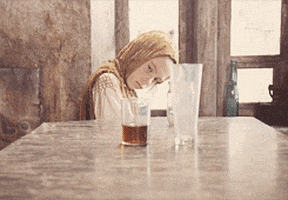
She was standing by the wall, close to the window, she had laid her arm
against the wall, and her head was pressed on her arm, she was standing like
that thinking. And she was standing so deep in thought that she did not hear me
come and look at her from the other room. She seemed to be smiling—standing,
thinking and smiling (Dostoevsky, A Gentle Spirit).
The reason why the meek one smiles before committing
the fatal act is absolutely impenetrable to the hero and also to us. What
understanding can the poor girl have reached? “Standing, thinking and smiling”—what
could be more paradoxical, more surreal, more real to the highest degree than
this scene fashioned in the mind of the great writer? It seems that the
solution to this gesture (for gesture it is!), to this mystery, would
automatically lead to an understanding of life, of the world itself. Probably
Dostoevsky confronts us with this gesture, this mystery, in order to make us
marvel at female nature, which in essence expresses the whole of human nature.
And perhaps by her very nature, woman is closer to the transcendent and
therefore capable of achieving that higher understanding, which leads to
self-reconciliation. No other explanation relating to the immanence of this
world would have been conceivable. You cannot in any wise penetrate to the
meaning of the thought that expresses perhaps the very essence of the feminine
whole, even the very essence of life itself and therefore the supreme
understanding of life. Or perhaps this was in the natural way of things, that
what happened should happen, because there was no “other solution.” The meek
one, as a woman, is perhaps capable of seeing what men cannot and will never be
able to see. Or perhaps in this world, this is the natural order:
an organic incompatibility between the two principles, male and female. Perhaps
this is why the main character, the moneylender, is not so guilty for his
wife’s death, since, as one of the novella’s critics so aptly puts it: “the
guilt far outstrips the guilty party, it no longer belongs to him, but to the
entire universe, which is structured crookedly, built on suffering, and which
nobody anywhere will ever be able to redeem.” A conclusion that is
like the passing of a sentence!

Monday, April 4, 2016
In love with Tarkovsky - The Metaphysical Hypothesis
Another paragraph from my book "In love with Tarkovsky" translated by Alistair Ian Blyth:
“Absolute”, “Transcendent”, “Spirituality”, the “Thing-in-itself”, “Salvation” are concepts that might appear strange or at best unnatural in a “modern”, “civilised” society. But let us turn back time a little: let us picture for ourselves the atmosphere during the communist regime, the limited access to information, the psychological pressure and the continual ideological bombardment, the queues for the most basic foodstuffs, the total lack of freedom, and all the rest. To live in that gulag day after day and to end up asking yourself over and over again the fundamental question that the “Writer” asks himself in Stalker: “But what is it that I want in fact?” What do I want and what do I have to do in order to live authentically? What do I have to do in order to find my salvation as an individual living in this hostile world? It is a universal question, which perhaps requires a universal answer, that is, an answer valid in any time and in any place. But the answer to this question appears to differ at first sight. Because in those times dominated by fear, there were not very many choices (and nor are there today, perhaps). It seemed that you have only one choice: the experience of art. The desperate attempt to attain the “Absolute” somehow, using your limited powers. I was convinced that this was possible and that it was only a matter of searching, as Tarkovsky convincingly suggested.
“Absolute”, “Transcendent”, “Spirituality”, the “Thing-in-itself”, “Salvation” are concepts that might appear strange or at best unnatural in a “modern”, “civilised” society. But let us turn back time a little: let us picture for ourselves the atmosphere during the communist regime, the limited access to information, the psychological pressure and the continual ideological bombardment, the queues for the most basic foodstuffs, the total lack of freedom, and all the rest. To live in that gulag day after day and to end up asking yourself over and over again the fundamental question that the “Writer” asks himself in Stalker: “But what is it that I want in fact?” What do I want and what do I have to do in order to live authentically? What do I have to do in order to find my salvation as an individual living in this hostile world? It is a universal question, which perhaps requires a universal answer, that is, an answer valid in any time and in any place. But the answer to this question appears to differ at first sight. Because in those times dominated by fear, there were not very many choices (and nor are there today, perhaps). It seemed that you have only one choice: the experience of art. The desperate attempt to attain the “Absolute” somehow, using your limited powers. I was convinced that this was possible and that it was only a matter of searching, as Tarkovsky convincingly suggested.

Sunday, March 6, 2016
Pina Bausch in "In love with Tarkovsky"
My meeting with Pina Bausch - excerpts from "In love with Tarkovsky" translated by Alistair Ian Blyth:
I was convinced that there was no hope, that I
would never again be capable of experiencing art as I had once experienced it,
when I saw Tarkovsky’s film Stalker for the first time during the
Ceaușescu regime. I was convinced that I would
not be able to, but in a wholly unexpected way it happened once again. I had
the same feeling once again. It was a miracle. It is true that I entered the
cinema with a certain hope, with faith even, but I would not have been able to
imagine that it could happen once more . . . I saw a film about one of the
greatest artists of the last century: German choreographer Pina Bausch, who
invented what we now call Tanztheater. The film was directed by Wim Wenders and
titled simply Pina 3D. It was the first 3D
film I had seen and I understood once again how the art could evolve, how it
could reinvent itself to capture sublime moments. The art of dance cannot be
described in words. And nor can you describe the feelings you have when you
view such a performance. By the end of the film I was absolutely fascinated. I
experienced the same feelings as when I saw Stalker in the communist
period: pure plenitude and self-fulfilment. I felt that without any shadow of a
doubt if the world ended in that instant I would remain eternally happy! Oh,
what happiness!
I experienced there art in solitude, but I knew
very well that what I understood, what I experienced, was a shared experience,
a shared meaning. I knew very well and I was aware that there were others like
me, who experienced the film or artwork in the same way or that they had
previously experienced it in the same way. Connexions established and unknown,
but essential, between those that share the same experience. Art was and is my
freedom: the freedom of lived and shared experiences.
I understand that the art of Pina Bausch, like
the art of Tarkovsky, provides me with that feeling that would be sufficient to
ground my entire existence: joy. It gives me hope and faith and I think
that it is no blasphemy to paraphrase the words of Florensky in this context:
“There exists the art of Tarkovsky and the art of Pina Bausch: therefore the
Spirit exists.” The “Other” exists, “presence” exists, which gives birth to
joy. Like the joy that I felt at the end of The Sacrifice, when the
child carries the two buckets of water, one by one, to water the withered tree,
the tree of lost faith, but which, with faith, can be brought back to life. It
is the joy of hope. Because in the end, it is not suffering, but joy
that is the mystery of life, its essence. The words of Prince Myshkin cannot be
true, when he puts forward that suffering is a spiritual thirst! I cannot
accept them; I cannot accept them any longer! Suffering is vulgar, as
someone once said. Joy is life’s miracle! Above all shared joy! This is the
purpose and the essence of life and of art in its entirety: the sharing of joy.
The joy of experiencing art and sharing that joy with others! To share their
joy! Let us therefore take joy in Tarkovsky!
Sunday, February 28, 2016
Conquering the world...
Conquering the world implies, inevitably, facing death, in one way or another. This would be trivial and pathetic if it were not real. Up there, on the crest, hooked on the ice and snow, you look down at the immensity of the abyss and you make your life statement. And the only thing you can cling to is that you had a joyful, fulfilled life. And you have always thought like that. But suddenly, you realise up there that that is not enough. You understand that much more important is that those who will survive you must share the same thought about you. They should be happy that you had a fullfiled life and not to lament you. The essence of life!


Wednesday, February 24, 2016
In Love with Tarkovsky
Alistair Ian Blyth has started translating my book Indragostit de Tarkovski in English. Here are some paragraphs:
In that small cinema auditorium, the miracle took place: in understanding the film, I had the feeling that I became immortal. In a fundamental way, this is also what the ultimate meaning of art should be. Finding those hidden meanings of art, experiencing art, the individual can be saved, can become immortal. Watching a Tarkovsky film, feeling it and experiencing it with all the intensity of which I was capable, I had a complete sense of immortality. It was not only Tarkovsky who could save himself, but also I, the humble viewer, who, by participating in the artistic act, by understanding and experiencing artistic expression, became immortal. I the unknown, I the talentless, but in possession of that boundless, almost Dostoevskian, desire to be saved at all costs, to find redemption.
I realised that this was a path as certain as that of the creative artist. And that I too could tread that path. Like the anonymous monk in his cell, silent and unknown to all, who ultimately finds the supreme salvation. I left the cinema transfigured. I felt that a genuine ontological transformation had taken place. Beyond the dark and troubling existential problems, I felt that I had become invincible. I had become truly immortal. The supreme self-salvation, individual salvation, there, in isolation, far from the world, without any parade, without any artificialities, without any irony: salvation through the experience of art. This was the authentic experience. It had become the purpose of life, its essence.
.....
I experienced there art in solitude, but I knew very well that what I understood, what I experienced, was a shared experience, a shared meaning. I knew very well and I was aware that there were others like me, who experienced the film or artwork in the same way or that they had previously experienced it in the same way. Connexions established and unknown, but essential, between those that share the same experience. Art was and is my freedom: the freedom of lived and shared experiences.
I understand that the art of Pina Bausch, like the art of Tarkovsky, provides me with that feeling that would be sufficient to ground my entire existence: joy. It gives me hope and faith and I think that it is no blasphemy to paraphrase the words of Florensky in this context: “There exists the art of Tarkovsky and the art of Pina Bausch: therefore the Spirit exists.” The “Other” exists, “presence” exists, which gives birth to joy. Like the joy that I felt at the end of The Sacrifice, when the child carries the two buckets of water, one by one, to water the withered tree, the tree of lost faith, but which, with faith, can be brought back to life. It is the joy of hope. Because in the end, it is not suffering, but joy that is the mystery of life, its essence. The words of Prince Myshkin cannot be true, when he puts forward that suffering is a spiritual thirst! I cannot accept them; I cannot accept them any longer! Suffering is vulgar, as someone once said. Joy is life’s miracle! Above all shared joy! This is the purpose and the essence of life and of art in its entirety: the sharing of joy. The joy of experiencing art and sharing that joy with others! To share their joy! Let us therefore take joy in Tarkovsky!
Wednesday, October 14, 2015

Thursday, August 29, 2013
Fyodor Dostoyevsky, The Brothers Karamazov
“The mystery of human existence lies not in just staying alive, but in finding something to live for.”
― Fyodor Dostoyevsky, The Brothers Karamazov
― Fyodor Dostoyevsky, The Brothers Karamazov
Wednesday, July 10, 2013

Demons - Dostoevsky
“Oh, I wish so much to live again! Each minute, each instant of life should be blessedness for man...they should, surely they should! It is man's own duty to arrange it so; it is his law--a hidden but surely existing one...”
― Fyodor Dostoyevsky, Demons
― Fyodor Dostoyevsky, Demons
Demonii - Dostoevsky
“Do you believe in a future everlasting life?
No, not in a future everlasting but in an everlasting life here. There are moments, you reach moments, and time comes to a sudden stop, and it will become eternal.”
― Fyodor Dostoyevsky, Demons
No, not in a future everlasting but in an everlasting life here. There are moments, you reach moments, and time comes to a sudden stop, and it will become eternal.”
― Fyodor Dostoyevsky, Demons

Thursday, May 23, 2013
Saturday, May 11, 2013
"He who teaches that all are good, will end the world." Dostoevsky, The Demons
“Man is unhappy because he doesn't know he's happy; only because of that. It's everything, everything, Whoever learns will at once immediately become happy, that same moment...
"And when did you find out that you were so happy?"
"Last week, on Tuesday, no, Wednesday, because it was Wednesday by then, in the night."
"And what was the occasion?"
"I don't remember, just so; I was pacing the room...it makes no difference. I stopped my clock, it was two thirty-seven."
"As an emblem that time should stop?"
Kirillov did not reply.
"They're not good," he suddenly began again, "because they don't know they're good. When they find out, they won't violate the girl. They must find out that they're good, then they'll all become good at once, all, to a man.
"Well, you did find out, so you must be good?"
"I am good."
"With that I agree, incidentally," Stavrogin muttered frowningly.
"He who teaches that all are good, will end the world."
"He who taught it was crucified."
"He will come, and his name is the man-god."
"The God-man?"
"The man-god--that's the whole difference."
"Can it be you who lights the icon lamp?"
"Yes, I lit it."
"You've become a believer?"
"The old woman likes the icon lamp...she's busy today," Kirillov muttered.
"But you don't pray yet?"
"I pray to everything. See, there's a spider crawling on the wall, I look and am thankful to it for crawling."
His eyes lit up again. He kept looking straight at Stavrogin, his gaze firm and unflinching. Stavrogin watched him frowningly and squeamishly, but there was no mockery in his eyes.
"I bet when I come the next time you'll already believe in God," he said, getting up and grabbing his hat.
"Why?" Kirillov also rose.
"If you found out that you believe in God, you would believe; but since you don't know yet that you believe in God, you don't believe," Nikolai Vsevolodovich grinned.”
Subscribe to:
Posts (Atom)