Thursday, May 5, 2016

"In love with Tarkovsky" translated by Alistair Ian Blyth

Every time I saw Tarkovsky’s Stalker the same thing happened: I remembered my entire life (as the Stalker asks his two companions to do). I sat in the cramped cinema and remembered my life. Snatches of images, thoughts, unfulfilled desires. Because I was constantly tortured by the same devastating thought, by the same striving to find a meaning to life. I knew that the only solution was to follow the Stalker’s imperative: “You must believe!” Which means: “You must change your life!” The same meaning. To believe in what? In freedom, first of all, that is, in the lived and shared experience, in the encounter with the other, in the encounter with other freedoms and above all the Idea within the framework of spirituality. To experience what others have experienced, to tread the same beaten paths, to feel what others have felt, the great ideas and the great desires. To walk the grand boulevard of great ideas. This is why I wanted to see and experience the films of Tarkovsky.


"The Meek One" in "In love with Tarkvosky", translation by Alistair Ian Blyth

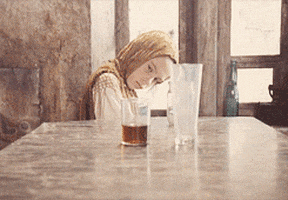
She was standing by the wall, close to the window, she had laid her arm against the wall, and her head was pressed on her arm, she was standing like that thinking. And she was standing so deep in thought that she did not hear me come and look at her from the other room. She seemed to be smiling—standing, thinking and smiling (Dostoevsky, A Gentle Spirit).
  
The reason why the meek one smiles before committing the fatal act is absolutely impenetrable to the hero and also to us. What understanding can the poor girl have reached? “Standing, thinking and smiling”—what could be more paradoxical, more surreal, more real to the highest degree than this scene fashioned in the mind of the great writer? It seems that the solution to this gesture (for gesture it is!), to this mystery, would automatically lead to an understanding of life, of the world itself. Probably Dostoevsky confronts us with this gesture, this mystery, in order to make us marvel at female nature, which in essence expresses the whole of human nature. And perhaps by her very nature, woman is closer to the transcendent and therefore capable of achieving that higher understanding, which leads to self-reconciliation. No other explanation relating to the immanence of this world would have been conceivable. You cannot in any wise penetrate to the meaning of the thought that expresses perhaps the very essence of the feminine whole, even the very essence of life itself and therefore the supreme understanding of life. Or perhaps this was in the natural way of things, that what happened should happen, because there was no “other solution.” The meek one, as a woman, is perhaps capable of seeing what men cannot and will never be able to see. Or perhaps in this world, this is the natural order: an organic incompatibility between the two principles, male and female. Perhaps this is why the main character, the moneylender, is not so guilty for his wife’s death, since, as one of the novella’s critics so aptly puts it: “the guilt far outstrips the guilty party, it no longer belongs to him, but to the entire universe, which is structured crookedly, built on suffering, and which nobody anywhere will ever be able to redeem.” A conclusion that is like the passing of a sentence!


Monday, April 4, 2016

In love with Tarkovsky - The Metaphysical Hypothesis

Another paragraph from my book "In love with Tarkovsky" translated by Alistair Ian Blyth:

“Absolute”, “Transcendent”, “Spirituality”, the “Thing-in-itself”, “Salvation” are concepts that might appear strange or at best unnatural in a “modern”, “civilised” society. But let us turn back time a little: let us picture for ourselves the atmosphere during the communist regime, the limited access to information, the psychological pressure and the continual ideological bombardment, the queues for the most basic foodstuffs, the total lack of freedom, and all the rest. To live in that gulag day after day and to end up asking yourself over and over again the fundamental question that the “Writer” asks himself in 
Stalker: “But what is it that I want in fact?” What do I want and what do I have to do in order to live authentically? What do I have to do in order to find my salvation as an individual living in this hostile world? It is a universal question, which perhaps requires a universal answer, that is, an answer valid in any time and in any place. But the answer to this question appears to differ at first sight. Because in those times dominated by fear, there were not very many choices (and nor are there today, perhaps). It seemed that you have only one choice: the experience of art. The desperate attempt to attain the “Absolute” somehow, using your limited powers. I was convinced that this was possible and that it was only a matter of searching, as Tarkovsky convincingly suggested.


Sunday, March 6, 2016

Pina Bausch in "In love with Tarkovsky"

My meeting with Pina Bausch - excerpts from "In love with Tarkovsky" translated by Alistair Ian Blyth:

I was convinced that there was no hope, that I would never again be capable of experiencing art as I had once experienced it, when I saw Tarkovsky’s film Stalker for the first time during the Ceaușescu regime. I was convinced that I would not be able to, but in a wholly unexpected way it happened once again. I had the same feeling once again. It was a miracle. It is true that I entered the cinema with a certain hope, with faith even, but I would not have been able to imagine that it could happen once more . . . I saw a film about one of the greatest artists of the last century: German choreographer Pina Bausch, who invented what we now call Tanztheater. The film was directed by Wim Wenders and titled simply Pina 3D.  It was the first 3D film I had seen and I understood once again how the art could evolve, how it could reinvent itself to capture sublime moments. The art of dance cannot be described in words. And nor can you describe the feelings you have when you view such a performance. By the end of the film I was absolutely fascinated. I experienced the same feelings as when I saw Stalker in the communist period: pure plenitude and self-fulfilment. I felt that without any shadow of a doubt if the world ended in that instant I would remain eternally happy! Oh, what happiness!


I experienced there art in solitude, but I knew very well that what I understood, what I experienced, was a shared experience, a shared meaning. I knew very well and I was aware that there were others like me, who experienced the film or artwork in the same way or that they had previously experienced it in the same way. Connexions established and unknown, but essential, between those that share the same experience. Art was and is my freedom: the freedom of lived and shared experiences.
I understand that the art of Pina Bausch, like the art of Tarkovsky, provides me with that feeling that would be sufficient to ground my entire existence: joy. It gives me hope and faith and I think that it is no blasphemy to paraphrase the words of Florensky in this context: “There exists the art of Tarkovsky and the art of Pina Bausch: therefore the Spirit exists.” The “Other” exists, “presence” exists, which gives birth to joy. Like the joy that I felt at the end of The Sacrifice, when the child carries the two buckets of water, one by one, to water the withered tree, the tree of lost faith, but which, with faith, can be brought back to life. It is the joy of hope. Because in the end, it is not suffering, but joy that is the mystery of life, its essence. The words of Prince Myshkin cannot be true, when he puts forward that suffering is a spiritual thirst! I cannot accept them; I cannot accept them any longer! Suffering is vulgar, as someone once said. Joy is life’s miracle! Above all shared joy! This is the purpose and the essence of life and of art in its entirety: the sharing of joy. The joy of experiencing art and sharing that joy with others! To share their joy! Let us therefore take joy in Tarkovsky!

Sunday, February 28, 2016

Conquering the world...

Conquering the world implies, inevitably, facing death, in one way or another. This would be trivial and pathetic if it were not real. Up there, on the crest, hooked on the ice and snow, you look down at the immensity of the abyss and you make your life statement. And the only thing you can cling to is that you had a joyful, fulfilled life. And you have always thought like that. But suddenly, you realise up there that that is not enough. You understand that much more important is that those who will survive you must share the same thought about you. They should be happy that you had a fullfiled life and not to lament you. The essence of life!


Wednesday, February 24, 2016

In Love with Tarkovsky

Alistair Ian Blyth has started translating my book Indragostit de Tarkovski in English. Here are some paragraphs:

In that small cinema auditorium, the miracle took place: in understanding the film, I had the feeling that I became immortal. In a fundamental way, this is also what the ultimate meaning of art should be. Finding those hidden meanings of art, experiencing art, the individual can be saved, can become immortal. Watching a Tarkovsky film, feeling it and experiencing it with all the intensity of which I was capable, I had a complete sense of immortality. It was not only Tarkovsky who could save himself, but also I, the humble viewer, who, by participating in the artistic act, by understanding and experiencing artistic expression, became immortal. I the unknown, I the talentless, but in possession of that boundless, almost Dostoevskian, desire to be saved at all costs, to find redemption.

I realised that this was a path as certain as that of the creative artist. And that I too could tread that path. Like the anonymous monk in his cell, silent and unknown to all, who ultimately finds the supreme salvation. I left the cinema transfigured. I felt that a genuine ontological transformation had taken place. Beyond the dark and troubling existential problems, I felt that I had become invincible. I had become truly immortal. The supreme self-salvation, individual salvation, there, in isolation, far from the world, without any parade, without any artificialities, without any irony: salvation through the experience of art. This was the authentic experience. It had become the purpose of life, its essence.

.....

I experienced there art in solitude, but I knew very well that what I understood, what I experienced, was a shared experience, a shared meaning. I knew very well and I was aware that there were others like me, who experienced the film or artwork in the same way or that they had previously experienced it in the same way. Connexions established and unknown, but essential, between those that share the same experience. Art was and is my freedom: the freedom of lived and shared experiences.
I understand that the art of Pina Bausch, like the art of Tarkovsky, provides me with that feeling that would be sufficient to ground my entire existence: joy. It gives me hope and faith and I think that it is no blasphemy to paraphrase the words of Florensky in this context: “There exists the art of Tarkovsky and the art of Pina Bausch: therefore the Spirit exists.” The “Other” exists, “presence” exists, which gives birth to joy. Like the joy that I felt at the end of The Sacrifice, when the child carries the two buckets of water, one by one, to water the withered tree, the tree of lost faith, but which, with faith, can be brought back to life. It is the joy of hope. Because in the end, it is not suffering, but joy that is the mystery of life, its essence. The words of Prince Myshkin cannot be true, when he puts forward that suffering is a spiritual thirst! I cannot accept them; I cannot accept them any longer! Suffering is vulgar, as someone once said. Joy is life’s miracle! Above all shared joy! This is the purpose and the essence of life and of art in its entirety: the sharing of joy. The joy of experiencing art and sharing that joy with others! To share their joy! Let us therefore take joy in Tarkovsky!